
Somerton House
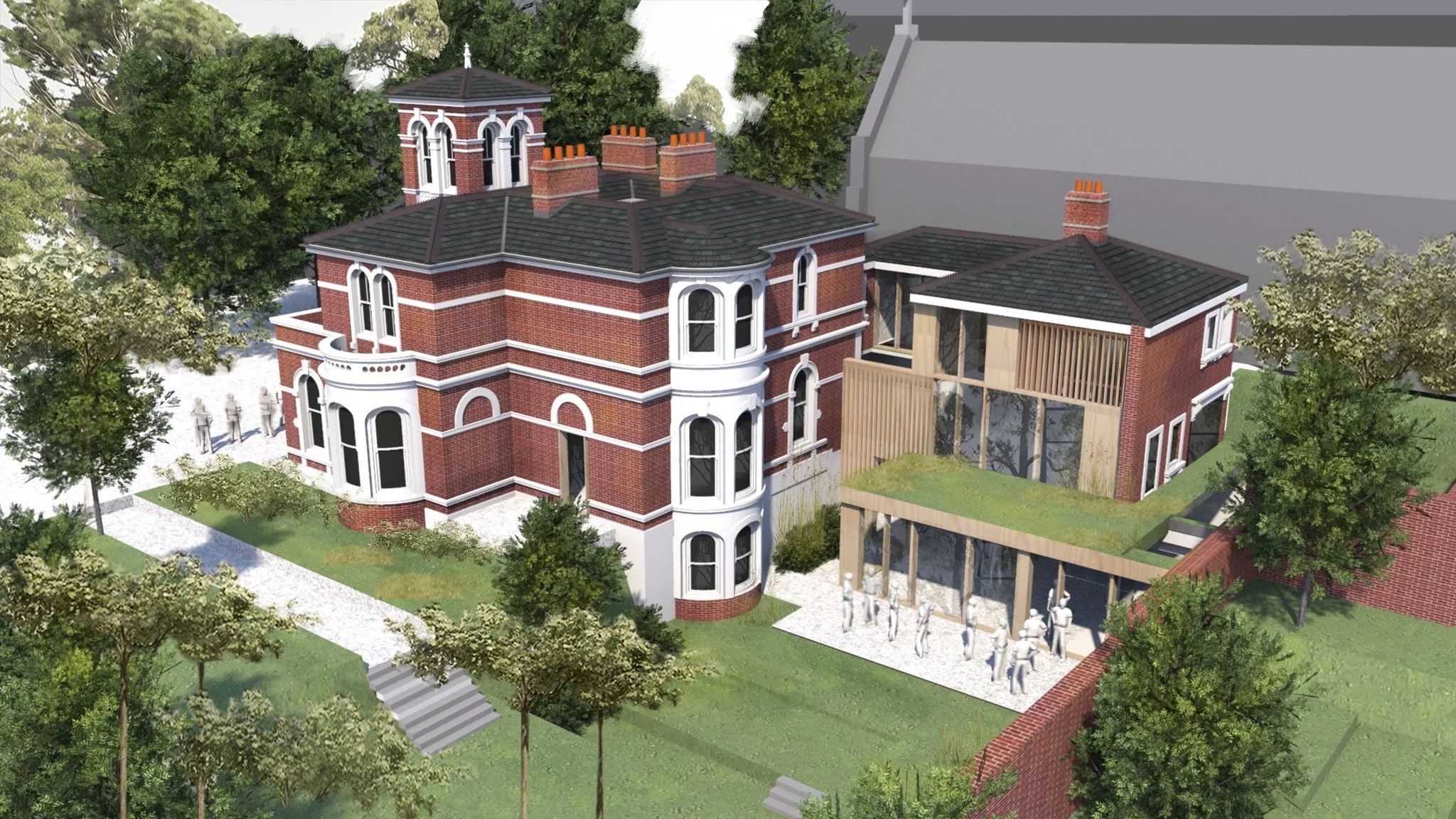
71 Somerton Road
first appears in Belfast’s records in 1877, named Eirene. It is a two-storey red brick Italianate mansion, in an asymmetrical style with a three storey tower. The building is believed to have been designed by architect John Lanyon, the son of one of Belfast’s most eminent architects Charles Lanyon. John Lanyon lived next door at 71 Somerton Road, and Eirene is similar in style to other buildings he designed such as Connolly Street Station in Dublin, and the Waterside Railway station in Derry/Londonderry. In the 1860s, Lanyon formed an architectural practice with his father and another prominent architect W.H Lynn, and Belfast Castle on the Antrim Road was one of their most well-known designs.
The city of Belfast first began as a small village near a ford across the River Lagan, and where the Farset and Blackstaff rivers met the Lagan. The village became a town by the 17th century, concentrated around the original site of Belfast Castle, in what is now the city centre and marked by Castle Place. Due to its successful merchants and increase in trade, the town began to expand outwards, along the main routes out of the town.
The Antrim Road area of North Belfast had previously been the site of grand country estates and large mansions such as Parkmount, Mount Vernon and Fortwilliam House. They were the summer residences of wealthy individuals such as William Sinclaire, a businessman who owned a bleaching works on the Falls Road and owned Fortwilliam House. The house and estate was sold to the wealthy merchant and shipowner George Langtry in 1810, before the site was acquired by the property developer James W Valentine in the 1860s. Valentine laid out large mansions for the increasingly wealthy Belfast residents, creating the gated community of Fortwilliam Park, still marked by the gate posts on the Antrim Road.
Somerton Road followed in the following decades, with houses such as Ardsallagh, Rosaville, Walton, Lisbreen and Dunlambert all constructed nearby. Like Eirene, many of the houses in Fortwilliam Park featured towers or turrets so that the shipowners, shipbuilders and merchants who lived there could watch the goings on in the Harbour and port. Notable residents in the surrounding streets include the shipbuilder George S Clark, who set up Workman Clark in the 1880s, Robert Thompson, a linen merchant, John Rogers, a wine manufacturer, and the historian George Benn.
The residents of Eirene
One of the first residents of 71 Somerton Road was Edward Crawford, a flour merchant and baker who had premises on North Street. He was followed by the banker William Spiller and his sisters Susan and Catherine, who acquired Eirene in 1884. William was the Assistant to the Director of the Belfast Bank, and after he passed away, his sister Susan remained in the house until 1914. The next resident was the shipbuilder Robert S Johnstone, who worked at the Workman Clark shipyard. He was only at Eirene for a few years before moving to Birkenhead to the engineering firm Cammell, Laird & Co.
The house was then acquired in 1920 by Lady Margaret McDowell, who made significant alterations and extensions to Eirene and renamed the building Ventnor. There is some evidence to suggest that Lady McDowell was the widow of Sir Alexander McDowell, a solicitor and partner in the law firm of Carson McDowell. The couple had previously built a large gentleman’s residence called Ventnor in Whiteabbey, but after Sir Alexander passed away in 1918, Lady Margaret sold the house. She then relocated to Eirene on the Somerton Road, and renamed the house Ventnor as well.
After Lady McDowell passed away in the 1950s, no. 71 Somerton Road was acquired by the Diocese of Down and Connor. The diocese had bought Lisbreen House next door at 73 Somerton Road in the 1930s, and in 1937 constructed the St Therese of Lisieux church in the grounds. Lisbreen House became the official residence for the Bishops of Down and Connor, and Eirene/Ventnor became the parochial house for the priests at St Therese’s.
Migration to Northern Ireland
Since at least the 18th century, there are records of people of different ethnicities and nationalities living and working in Northern Ireland, particularly in the city of Belfast. The area closest to the docks known as Sailortown was home to a mixed community of sailors, merchant seamen, dockers, and was where lots of Italians settled, in an area called Little Italy.
By 1901 Northern Ireland had residents from across the world, with people from Germany, Switzerland, Belgium, France, Denmark, Portugal, Hungary, Norway, Spain, Greece, Russia and Sweden all calling Belfast or towns in Northern Ireland home. Migrants worked in a range of occupations, with skilled workers such as engineers, designers and embroiderers, but also in low-paid occupations like domestic service and manual labour. Many of them were self-employed, and in 1917, there were fifty Italian cafes and ice cream shops across Belfast.
The 1920s saw Indian migrants arrive in Belfast, increasing in the 1950s and 60s, with the Indian Community Centre established in 1981 at Carlisle Circus. Migrants from Pakistan and Bangladesh began to call Northern Ireland home in the 1950s and 60s, and the region also had a growing Chinese population, who became the largest ethnic minority group in Northern Ireland until the mid 2000s. The rise of Chinese restaurants and takeaways from the 1970s onwards reflects the changing demographics of Northern Ireland.
2004 marked the accession to the European Union of 8 new member states, and an acceleration in migration across Europe. The UK saw almost 1 million migrants apply for the Worker Registration Scheme between 2004 and 2008, of which 66% were Polish. Belfast and Northern Ireland became home to a large contingent of Polish immigrants, settling in the city and raising families. The largest immigrant group in Northern Ireland is currently the Polish community.